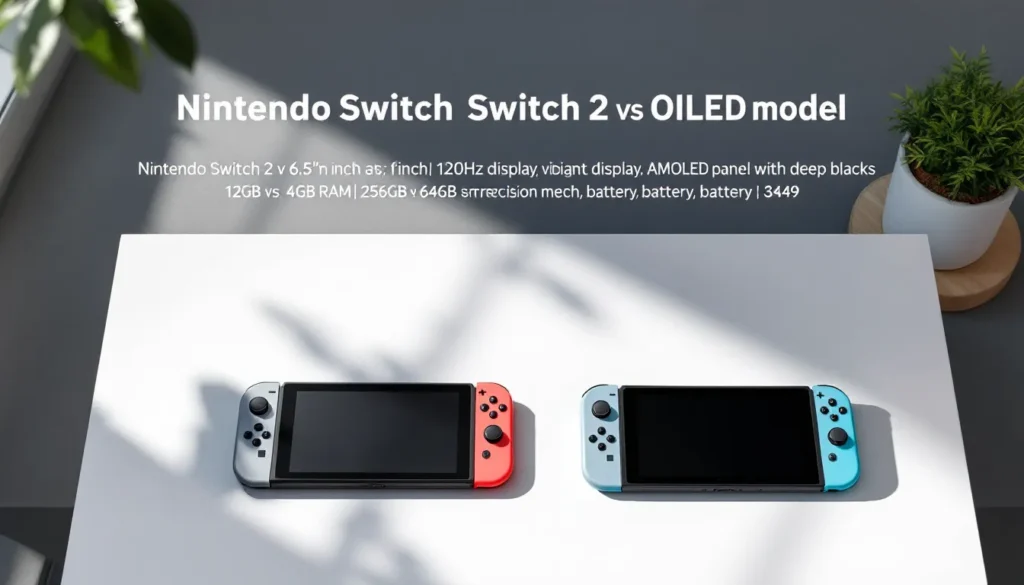
The Nintendo Switch ecosystem just got more complicated, and maybe better. With the Switch 2 officially out and the OLED model still commanding shelf space, gamers face a genuine dilemma. Both are solid consoles, but they’re built for different gamers with different priorities. The Switch 2 brings raw power and forward compatibility. The OLED model? It’s the refined experience Nintendo perfected on the original formula. This guide breaks down the hard specs, real-world performance, and exactly who should buy what. No fluff, no corporate speak, just the data gamers actually need to make the right call in 2026.
Key Takeaways
- The Nintendo Switch 2 delivers 10x the processing power of the OLED model with 2.6 teraflops docked, enabling AAA games at higher framerates and better graphics fidelity.
- Both consoles now cost $349, making the choice a matter of performance versus display quality rather than budget; OLED excels with its vibrant AMOLED panel while Switch 2 offers a larger 120Hz LCD screen.
- Switch 2 includes 256GB storage versus OLED’s 64GB, eliminating the need for immediate microSD card purchases for larger games like Elden Ring and Tears of the Kingdom.
- Backwards compatibility is near-perfect on Switch 2, meaning your existing Switch game library plays on the new console with enhanced performance.
- Core and competitive gamers should choose Switch 2 for future-proofed performance and long-term support, while casual players and families can enjoy OLED’s superior display at potential discounts without compromising gameplay.
- Switch 2’s LCD panel offers greater durability and lower burn-in risk compared to OLED, with an expected support window of 5-7 years for new games and optimization.
Hardware Specifications And Processing Power
CPU And GPU Performance
The Switch 2 uses an upgraded NVIDIA processor (custom Tegra) that delivers roughly 10x the docked performance of the original Switch. We’re talking approximately 1.6 teraflops handheld, 2.6 teraflops docked. The OLED model? It runs on the same chip as the original Switch, approximately 0.39 teraflops handheld, 0.65 teraflops docked. That’s a massive gulf in raw compute.
What does this mean in practice? The Switch 2 runs demanding games at higher framerates and better graphical fidelity. Third-party AAA titles that originally launched on PS4/Xbox One now run closer to their console versions on Switch 2. The OLED struggles with the same ports, often dropping to 720p or lower framerates to maintain stability.
How Powerful is the Nintendo Switch? covers the original Switch’s limitations in detail, Switch 2 simply obliterates those constraints.
RAM And Storage Capabilities
Switch 2 doubles RAM to 12GB (versus 4GB on OLED), which matters for complex game worlds and smoother multitasking. Storage? Switch 2 ships with 256GB internal: OLED maxes out at 64GB. Both support microSD expansion, but Switch 2’s larger base storage means fewer headaches for players who bounce between titles.
The OLED’s 64GB is honestly tight when games like The Legend of Zelda: Tears of the Kingdom (18GB) and Elden Ring (60GB) exist. You’ll almost certainly need a microSD card. Switch 2’s 256GB gives breathing room. Neither console includes a microSD in the box anymore, so factor that into your initial cost.
Display Technology And Screen Quality
OLED Panel Features And Benefits
The Switch OLED’s 6.2-inch OLED panel is genuinely gorgeous. OLED tech means true blacks (pixels emit their own light), infinite contrast ratios, and vibrant colors without backlight bleed. For games like Metroid Dread or Kirby and the Forgotten Land, that pop is noticeable and satisfying.
Response time is snappy too, around 1ms for pixel transitions, crucial for fast-paced action games. Colors are accurate, brightness reaches 400 nits in boost mode, and there’s no dead angle where the picture washes out. This is what Nintendo nailed: the OLED feels premium because it fundamentally is.
Battery life also benefits from the panel: roughly 4.5 to 9 hours depending on what you’re playing, versus 4.5 to 6.5 on the original Switch.
Switch 2 Display Advancements
The Switch 2 uses a 6.5-inch LCD with a 120Hz refresh rate (the OLED maxes at 60Hz). That’s a jump in smoothness, especially for scrolling menus and 60fps games that now actually feel fluid. The resolution remains 1280×720 in handheld mode, same as OLED.
Switch 2’s LCD isn’t OLED, so blacks appear as dark grays and contrast is lower. But, the brighter peak brightness (up to 500 nits) and larger screen size compensate somewhat. For competitive games or anything running at 120fps, the higher refresh rate is a legitimate advantage.
One thing worth noting: LCD panels have a longer lifespan than OLED and are less prone to burn-in, which isn’t a huge risk for consumer displays but matters for devices you’ll use 8+ hours daily. The tradeoff is image quality per pixel.
Price And Value Proposition
Initial Launch Pricing
Switch 2 launched at $349 USD. The OLED model currently sits at $349 as well (Nintendo dropped the price to match Switch 2). The original Switch still retails for $299 with occasional discounts.
Here’s the honest take: $50 less for OLED versus Switch 2 doesn’t exist anymore. They’re the same price. That changes the calculus, you’re not choosing between entry-level and premium, but between a newer, more powerful console and a more refined but aging display.
Discover Affordable Newegg Nintendo Switch Deals often shows OLED units discounted to $299-$320 during sales, which occasionally undercuts Switch 2. Patience on OLED might save you money short-term.
Long-Term Value And Durability
Switch 2 is the new platform. Nintendo will support it for 5-7 years minimum, meaning new games, patches, and online infrastructure improvements will favor it. Buying OLED now means accepting a console that’s already entered its maintenance phase. Games will still release, but optimization goes to Switch 2.
Durability-wise, LCD panels in Switch 2 are tougher than OLED. The original OLED model has shown zero burn-in issues in the wild (Nintendo apparently solved that problem from other manufacturers’ OLED experiences), but LCD just has a longer proven lifespan in consumer electronics. Neither console feels fragile if you treat it decently.
Resale value favors Switch 2. Used OLED units will drop faster once the novelty wears off and Switch 2 adoption accelerates. If you plan to upgrade in 3-4 years, Switch 2 retains better value.
Game Library And Backwards Compatibility
Switch 2 Exclusive Titles And Future Games
Here’s the kicker: every physical Switch game works on Switch 2. Backwards compatibility is 99%+ across the board. That $300 of games you own? Still playable, often with better performance.
Switch 2 exclusives are rolling out gradually. We’re seeing enhanced ports of existing titles (running at higher framerates, better res) and genuinely new games optimized only for Switch 2. By 2027, the library split becomes obvious, AAA third-party games target Switch 2, while smaller indie titles and Nintendo’s first-party roster support both.
GTA on Nintendo Switch originally ran at 30fps, 1080p docked, 720p handheld. Switch 2 achieves 60fps docked, much sharper visuals. That’s the tangible upgrade path.
Nintendo’s own titles (Mario, Zelda, Pokémon gen X+1) will be developed for Switch 2 as the priority, with OLED ports if feasible. Essentially, you’re buying into the future of the ecosystem by going Switch 2.
OLED Game Performance And Optimization
Every game released for Switch works perfectly on OLED. Performance-heavy titles still hit the same framerates and resolutions as the standard Switch. Developers didn’t optimize for OLED’s panel because it runs identical hardware.
That said, the OLED’s superior screen does make games look better even though identical resolution. Tears of the Kingdom looks sharper and more vibrant on OLED’s AMOLED tech, not because of performance, but raw panel quality. Subjective? Slightly. Noticeable? Yes.
The trade-off: future games skew toward Switch 2. OLED will keep running new releases for 2-3 more years, but performance budgets will tighten. That $60 3D game in 2028 might be 30fps on OLED versus 60fps on Switch 2.
Battery Life And Portability
The OLED model edges out Switch 2 slightly on battery life. You’re looking at approximately 4.5 to 9 hours on OLED versus 4.5 to 8 hours on Switch 2, depending on the game (demanding titles drain faster). In real-world use, the difference is minimal, one extra 30 minutes of Hades per charge is barely noticeable.
Switch 2’s larger screen (6.5″ versus 6.2″) and faster processor justify the slightly shorter battery. Heat management is reportedly solid, so the console doesn’t get uncomfortably warm during extended sessions.
Portability is a wash if you’re hauling either in a bag. The Switch 2 is fractionally thicker and heavier (slightly), but you won’t feel it. If you’re specifically playing while lying in bed or on your stomach, the OLED’s smaller bezels and existing third-party stand ecosystem might matter. Switch 2 stand options are still rolling out.
For commuting or travel? Both work fine. You’ll want a USB-C power bank either way (USB-C charging on both), so portability differences shouldn’t drive your decision.
Design And Build Quality
Ergonomics And Controller Features
The Switch 2 keeps the docking system mostly the same but improves the Joy-Con rails with better precision mechanisms. Stick drift, that infamous original Switch problem, is supposedly eliminated with updated Hall-effect sensors. The OLED model addressed this with incremental improvements, but Switch 2 nails it more comprehensively.
The larger screen on Switch 2 doesn’t make the console noticeably bigger in your hands because Nintendo trimmed bezels smartly. Grip comfort is comparable. Button layout is identical, so muscle memory transfers immediately.
The OLED’s matte finish on the back resists fingerprints better than Switch 2’s glossier plastic. It’s a minor detail, but if you’re particular about smudges, OLED wins that round.
Durability And Materials
Both consoles use quality plastics and metal reinforcements where it matters (dock contacts, hinge). Neither feels cheap. The OLED model has proven rock-solid through millions of units sold, no systemic failure patterns.
Switch 2 is too new to have long-term durability data, but NVIDIA’s Tegra history and Nintendo’s QA processes suggest reliability won’t be an issue. The LCD panel is more durable than OLED over 5+ year lifespans.
Hinge durability is identical between both (same design inherited from original Switch). Most failures happen from rough handling, not manufacturing defects. Use a screen protector and don’t fold it aggressively, and both survive years of daily use.
Unmissable Nintendo Switch Labor Day Sale often bundles protective cases and tempered glass, good investments for either console regardless of your choice.
Which Console Is Right For You
Casual Gamers And Family Play
If you play Animal Crossing, Mario Kart, Nintendo Sports, and local multiplayer with family, the OLED model is honestly fine. Those titles don’t stress hardware, and the superior screen makes everything look prettier. You’ll be perfectly happy, and you might score OLED at a discount since it’s no longer the flagship.
Casual gaming doesn’t demand 120fps or teraflop counts. Performance parity is total. The OLED’s AMOLED panel makes colors pop nicely for cozy, colorful games. Plus, if you’ve already got a library of Switch games, buying OLED means zero friction with backwards compatibility.
Family play often involves shorter sessions, so the slightly lower battery life on Switch 2 becomes irrelevant. Durability is equal, and both handle docked play (connected to your TV) identically.
Competitive And Core Gamers
Switch 2 is your console. If you care about framerates, resolution clarity, or playing cutting-edge ports at their best, the extra processing power matters. Fortnite at 60fps docked (not available on OLED), Palworld with better draw distance, and future AAA games benefit directly from Switch 2’s hardware.
Competitive games like Super Smash Bros. (if a new version targets Switch 2) will likely leverage the 120Hz panel for smoother gameplay and reduced input lag. Core players notice that stuff.
The extra RAM means less dynamic resolution scaling and fewer performance compromises. Games feel more optimized, less like ports that make concessions. For players sinking 100+ hours into a single title, those optimizations compound.
Long-term, if you plan to play Nintendo’s big releases over the next 5 years, Switch 2 ensures you’re not left behind when optimization focuses there. Can You Stream on Nintendo Switch? gets easier too, Switch 2’s extra GPU headroom means streaming apps run smoother.
Reviews from IGN, Eurogamer, and VGC consistently note that Switch 2’s performance ceiling justifies the purchase for players who want Nintendo’s console to keep pace with their expectations through 2030.
Conclusion
The Nintendo Switch 2 vs OLED choice comes down to your horizon. OLED is the refined past, a beautifully optimized console that plays everything available right now with a stunning screen. It’s a known quantity, and if you snag a discount, it’s still solid value.
Switch 2 is the future. More power, longer support window, better long-term optimization, and a display that prioritizes smoothness over visual pop. The performance gap widens over the next 2-3 years as developers write directly for Switch 2.
For most core gamers, competitive players, and anyone planning to own this console past 2028, Switch 2 is the smart buy. For casual gamers, families, or anyone primarily playing Nintendo’s established catalog, OLED works perfectly, especially at discount.
Both are good consoles. Switch 2 is just better positioned for what comes next.