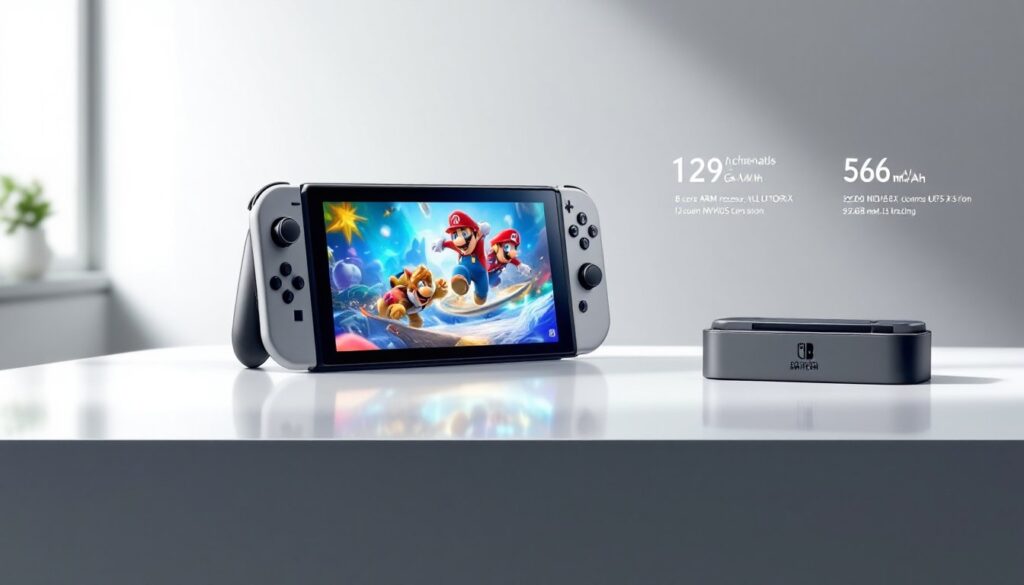
Nintendo Switch 2 is officially here, and it’s a serious generational leap. The new console packs an 8-core ARM processor, 12 GB of RAM, a custom NVIDIA GPU with hardware-accelerated DLSS and ray tracing, and a stunning 7.9-inch 1920×1080 HDR display that can push up to 120 fps. Whether you’re upgrading from the original Switch or considering your first handheld, understanding Switch 2 hardware specs is crucial before dropping $300+. This guide breaks down processor performance, display tech, memory, battery life, graphics capabilities, and connectivity features so you know exactly what you’re getting.
Key Takeaways
- Nintendo Switch 2 specs deliver a 7× performance boost with an 8-core ARM processor, 12 GB of RAM, and 256 GB storage, making it dramatically more capable than the original Switch.
- The 7.9-inch 1920×1080 HDR display supports up to 120 fps handheld and outputs 4K at 60 fps when docked, offering a significant visual upgrade over previous Nintendo consoles.
- Hardware-accelerated DLSS and ray tracing support allow developers to render demanding games at 4K resolution without sacrificing frame rates.
- Battery life ranges from 2–6.5 hours depending on game intensity and screen brightness, with a 3-hour charge time for full play sessions.
- Wi-Fi 6, dual USB-C ports, LAN connectivity, and backward compatibility with original Switch games make the console future-proof for online gaming and digital libraries.
Processor and Performance Upgrades
The Switch 2’s custom NVIDIA processor (Tegra T239 family) is the real story here. It’s built on an 8-core ARM Cortex-A78C architecture running at approximately 1.1 GHz in handheld mode and 1.0 GHz when docked, clocks are intentionally lower to manage thermals in a portable form factor. The GPU side uses Ada-derived NVIDIA architecture with 6 Texture Processing Clusters (TPCs), each packing 2 SMs of 128 CUDA cores, totaling around 1,536 CUDA cores. This translates to roughly 3 TFLOPS of FP32 performance when docked, comparable to a GTX 1050 Ti.
The performance uplift versus the original Switch sits around 7–7.5× in many real-world gaming scenarios, according to Digital Foundry and hardware teardown analyses. In handheld mode, you’re looking at GTX 750 Ti-class rasterization performance, which is legitimately impressive for mobile gaming. That gap between handheld and docked performance is why developers can offer meaningful visual upgrades when you dock the console. Hardware DLSS and ray tracing support mean developers aren’t just chasing raw polygon counts, they’ve got intelligent upscaling and advanced lighting to work with.
Display and Screen Technology
The 7.9-inch wide-color-gamut LCD capacitive touchscreen is a massive upgrade from the original Switch‘s smaller, lower-res panel. Resolution tops out at 1920×1080 whether you’re playing in handheld or tabletop mode, with variable refresh rate support up to 120 Hz. That means buttery-smooth frame rates on the go if developers want to target 120 fps at lower resolution. HDR10 support on the internal display gives supported games deeper blacks and brighter highlights, a feature the original Switch lacked entirely.
When docked, the Switch 2 outputs via HDMI to your TV, supporting up to 3840×2160 (4K) at 60 fps or 120 fps at 1080p/1440p. A built-in brightness sensor automatically adjusts the screen brightness, which matters when you’re gaming in different lighting conditions. The jump from the original Switch’s 6.2-inch 720p LCD to this 7.9-inch 1080p HDR panel is night and day, text is sharper, colors pop more, and games that support the higher refresh rate feel noticeably snappier when playing handheld.
Memory and Storage Capacity
The Switch 2 doubles down on memory with 12 GB of LPDDR5X (two 6 GB Hynix chips running at 8533 MT/s, though typically downclocked for efficiency). About 9 GB is available to games, with the remaining 3 GB reserved for the OS and system functions. This is a critical spec: the original Switch had only 4 GB, and that bottleneck forced developers to make painful compromises. The Switch 2’s 12 GB means ports of current-gen titles can exist without severe asset degradation.
Internal storage sits at 256 GB via UFS 3.1, a massive jump from the original Switch’s paltry 32 GB. You’ll need Nintendo Switch 2 SD card expansion for large game libraries, and the console supports a microSD Express card slot with up to 2 TB capacity. Standard microSD cards work too, but only for screenshots and videos. The Switch 2 also plays original Switch game cards, so your existing library isn’t abandoned, though eShop performance will vary depending on game optimization.
Battery Life and Power Efficiency
Nintendo equipped the Switch 2 with a 5220 mAh Li-ion battery, rated for approximately 2–6.5 hours of play depending on game load and screen brightness. That range exists because a demanding title at full brightness and 120 fps will drain battery far faster than a turn-based indie game at 50% brightness. Real-world testing shows lightweight games and native 720p/60 fps experiences can stretch toward the upper end, while GPU-intensive games with ray tracing active land closer to 2–3 hours.
Charging takes roughly 3 hours when the console is in Sleep mode, and the power delivery architecture uses a two-phase PMIC capable of handling up to 34.4 W at the board level, though the SoC itself typically operates at much lower power for thermal and portable constraints. The charging time isn’t much worse than the original Switch, so you’re not waiting days between gaming sessions.
Graphics and Gaming Performance
Graphics performance is where the Switch 2 finally feels like a current-generation device. Hardware-accelerated DLSS (Deep Learning Super Sampling) is built directly into the GPU, allowing developers to render at lower native resolution and intelligently upscale to full resolution without the blurriness of traditional upscaling. This tech is crucial for hitting 4K60 docked on demanding games, native 4K rendering would tank frame rates.
Ray tracing support enables realistic reflections, shadows, and lighting without the massive performance overhead of baked-in or screen-space approximations. Early third-party analysis suggests the Switch 2 sits somewhere between PS4 and PS4 Pro in raw throughput, depending on workload. Docked gameplay targeting 4K60 with DLSS is realistic. Handheld performance edges close to Steam Deck territory. Most titles will offer resolution vs. performance modes, think 4K30 fidelity or 1440p60 balanced, leveraging dynamic resolution scaling to maintain frame rate targets when action heats up. Check gaming hardware comparisons for real-world benchmark data as more games launch.
Design, Build, and Connectivity Features
The Switch 2 measures approximately 4.5 inches tall by 10.7 inches wide by 0.55 inches thick with Joy-Con attached, weighing around 0.88 lb (1.18 lb with controllers). It’s slightly larger and heavier than the original Switch, but the added screen real estate and better thermals justify the trade-off. Two USB-C ports live on the bottom (for charging/dock) and top (for accessories), plus a 3.5 mm audio jack, game card slot, and microSD Express slot.
The Joy-Con 2 controllers feature HD Rumble 2 (an improved haptic engine), accelerometer, gyroscope, and an integrated “mouse sensor” for pointer-style input, useful for menus and certain game genres. Right Joy-Con includes NFC for amiibo support. Each controller packs a 500 mAh battery good for ~20 hours of play: 3.5 hours to charge when attached or in the grip.
The dock is compact at 4.5 inches tall by 7.9 inches wide, featuring two USB 2.0 Type-A ports, HDMI, LAN port (for wired internet), and an AC power connector. Wi-Fi 6 and Bluetooth handle wireless connectivity, and the LAN option eliminates packet loss during online competitive play. Stereo speakers and a built-in mic with noise cancellation round out audio, with 5.1ch Linear PCM support via HDMI. Joy-Con compatibility and performance extends to the Switch 2, though new hardware supports enhanced features. A Pro Controller ($79.99) and optional camera accessory ($49.99) are available separately.
Conclusion
Nintendo Switch 2 represents a genuine hardware evolution: 7× performance boost, 1080p/120 Hz HDR handheld gaming, 4K docked output with DLSS, 12 GB RAM, and 256 GB storage. The processor delivers real gaming improvements without sacrificing portability, and Switch 2 versus OLED comparisons show it’s worth the investment if you game frequently across handheld and TV modes. With backward compatibility, Wi-Fi 6, and superior display tech, the Switch 2 stands as Nintendo’s most capable console yet.