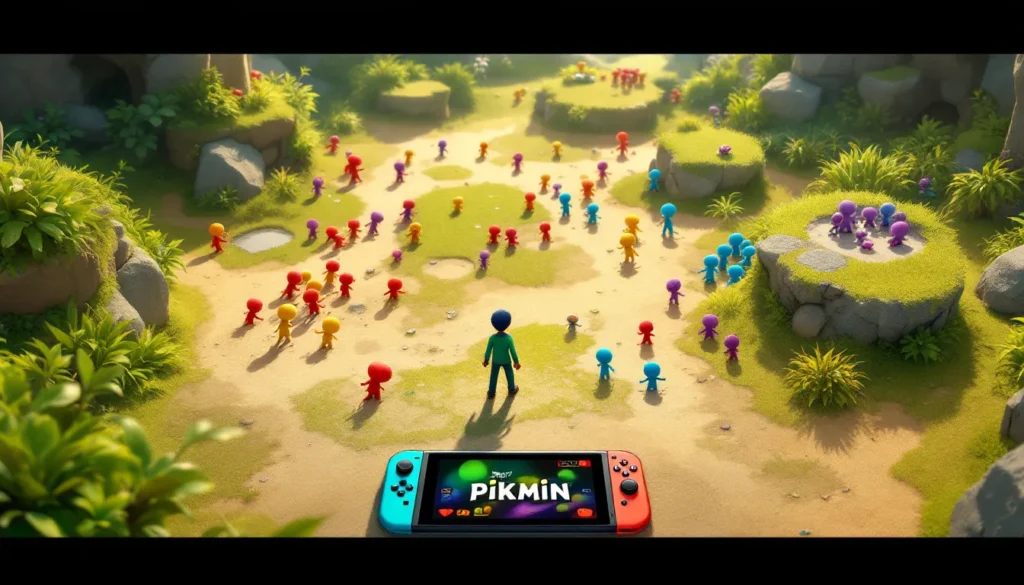
Pikmin on Nintendo Switch has evolved into one of the console’s most rewarding experiences, blending real-time strategy with exploration in ways that keep both casual and hardcore players coming back. Whether you’re managing squads of tiny creatures, optimizing resource gathering, or tackling increasingly difficult bosses, Pikmin demands strategic thinking without requiring twitch reflexes. The series on Switch spans multiple generations, from enhanced ports of the originals to innovative new entries, making it an ideal entry point for newcomers and a nostalgia trip for veterans. This guide covers everything from core mechanics to advanced tactics, ensuring you’ll master every aspect of Pikmin gameplay.
Key Takeaways
- Pikmin on Nintendo Switch blends real-time strategy with exploration, making it a must-play that appeals to casual and hardcore players alike through squad-based problem-solving and tactical combat.
- Pikmin 3 Deluxe is the recommended starting point for newcomers, offering the most polished mechanics, three simultaneous leaders, and substantial post-campaign content that provides surprising strategic depth.
- Mastering Pikmin demands understanding each type’s strengths—Blue for water, Rock for armor, Purple for heavy lifting—and assembling the right squad composition for each mission’s terrain and enemies.
- Efficient resource gathering constitutes about 60% of Pikmin gameplay, and veterans separate themselves by optimizing routes, avoiding backtracking, and identifying high-value targets rather than chasing every pellet.
- Boss fights require learning enemy attack patterns, exploiting specific weaknesses, and spreading squad positioning strategically to minimize casualties rather than rushing encounters unprepared.
- The Nintendo Switch’s portability makes Pikmin uniquely accessible across handheld, docked, and tabletop modes, while local co-op and active community leaderboards extend replay value far beyond the campaign.
What Is Pikmin and Why It’s a Nintendo Switch Must-Play
Pikmin is a real-time strategy action game where you control a leader character commanding small, plant-like creatures called Pikmin in direct combat and resource collection. The core appeal lies in squad-based problem-solving: different Pikmin types have unique abilities, and you’ll constantly swap between them to overcome environmental puzzles, gather resources, and defeat enemies.
What makes Pikmin special is its blend of genres. It’s not pure strategy, you’re actively moving your character and directing squads in real-time. It’s not a shooter, yet combat feels tactical and satisfying. It’s not a puzzle game, but every encounter presents a puzzle to solve. This genre-bending design resonates across skill levels. Casual players enjoy the relaxed exploration and narrative, while competitive players optimize squad management and route efficiency to beat speed-run times or maximize daily hauls.
On Nintendo Switch specifically, Pikmin benefits enormously from the console’s portability. You can play in handheld mode during commutes, dock it for a larger experience, or use tabletop mode for multiplayer sessions. The Switch’s hardware handles the series beautifully, delivering the visual fidelity needed to appreciate Pikmin’s charming art style while maintaining stable performance during hectic squad command moments.
The franchise appeals to a broad audience: strategic thinkers love the resource optimization, action fans appreciate the real-time combat, and everyone enjoys Pikmin’s personality and world-building. That accessibility combined with surprising depth makes Pikmin on Switch a genuine must-play.
Game Overview: Pikmin Titles Available on Switch
Nintendo Switch offers multiple Pikmin experiences, each with distinct mechanics and appeal. Understanding which version suits your needs is critical for getting the most out of the series.
Pikmin 1 and 2 on Nintendo Switch Online
Both the original Pikmin and Pikmin 2 are available through Nintendo Switch Online’s Game Boy Advance emulation service. These aren’t enhanced ports, they’re the original games running on original hardware emulation, which preserves the authentic experience but means graphics, controls, and interface remain unchanged from the 2001 and 2004 originals.
Pikmin 1 is the series blueprint: stripped-down, elegant, and punishing. You have just 30 days to explore the planet, harvest resources, and prepare your ship for departure. Every action costs time, creating constant tension and forcing strategic decisions about where to explore and what to prioritize. The game intentionally doesn’t explain everything, rewarding player discovery and adaptation.
Pikmin 2 expands everything: longer campaigns, new Pikmin types (White and Purple), caves with procedurally varied layouts, and multiplayer modes. It’s more forgiving than Pikmin 1 but demands better squad management in its late-game content. The cave system introduces randomization, making repeat runs feel fresh.
Access requires a current Nintendo Switch Online subscription. The experience works well in handheld mode, though the smaller screen makes some UI elements harder to read compared to docked play.
Pikmin 3 Deluxe: Enhanced Edition for Switch
Pikmin 3 Deluxe is a substantial upgrade to the original Wii U title, optimized specifically for Switch. This is where modern Pikmin gameplay solidifies: three simultaneous leaders, a rock Pikmin type, new traversal mechanics, and polished mission design across campaign and challenge modes.
The graphics are crisp and colorful, running at 60 FPS in handheld and docked modes. The campaign is longer than Pikmin 1 or 2, with more complex encounters and environmental variety. The Pikmin 3 squad system, managing multiple leaders independently, is where the game’s strategic ceiling reaches impressive heights.
Deluxe adds significant post-campaign content: new challenges, alternate costumes, and difficulty modifiers that extend playtime significantly. If you’re new to Pikmin, Pikmin 3 Deluxe is the recommended starting point. It’s forgiving enough for beginners but deep enough for strategy enthusiasts.
Pikmin 4: A Unique Handheld Experience
Pikmin 4 (3DS exclusive at launch, later ported to Switch as Pikmin 4) was designed ground-up for handheld gaming and remains the most focused entry in the franchise. It’s shorter than Pikmin 3, with tighter mission design and enhanced hand-holding for newcomers through the “hints” system.
The unique selling point: your leader can ride Pikmin like allies rather than pure soldiers. This fundamentally changes movement speed and traversal, making the game feel different from other entries. Pikmin 4 also introduced the “Challenge Mode,” which evolved into the time-attack and score-based challenges that dominate endgame play in modern entries.
Pikmin 4 isn’t currently on Switch natively (it’s a 3DS title), but if you’re considering the full Pikmin experience on Switch, understanding its legacy and design decisions enriches your appreciation of how the series evolved toward Pikmin 3 Deluxe.
Core Gameplay Mechanics and How to Master Them
Pikmin gameplay revolves around commanding, managing, and optimizing your squad. Mastering these mechanics separates casual players from efficient ones.
Commanding Your Pikmin Squad
At its core, Pikmin is squad management under real-time pressure. You direct Pikmin using the Switch’s Joy-Con controllers: throw them at targets, call them back, and organize them into formation. The basics are intuitive, but depth lies in precision.
When you throw a Pikmin, it travels a ballistic arc. Learning throw distance, angle, and timing is essential. Throw too short and Pikmin miss their target: throw too far and they scatter. Different Pikmin types land differently, heavier types like Rock Pikmin travel shorter distances. Mastering throw mechanics lets you land Pikmin exactly where needed, which matters enormously during boss fights where each creature counts.
Forming squads is critical. You can group Pikmin by type or split leaders to manage multiple squads simultaneously. In Pikmin 3 Deluxe, commanding three separate leaders demands coordination: send one squad to gather resources while another fights, and the third solves environmental puzzles. Failing to multitask efficiently wastes time and resources.
Resource Management and Time Constraints
Every Pikmin game operates under time pressure, though the nature varies. Pikmin 1 forces you to complete objectives within 30 days. Pikmin 3 Deluxe gives you unlimited days but limited expedition time per cycle. Pikmin 4 uses a hybrid system. This time constraint is the game’s core tension: it forces you to prioritize objectives, plan routes, and abandon certain goals.
Resource management extends beyond time. Pikmin are finite and mortal. Losing 50 Pikmin to an enemy wipes out your workforce temporarily, costing significant productivity. Death isn’t permanent, you’ll regrow lost Pikmin in your onion overnight, but it’s a meaningful setback. This creates tension where every combat encounter involves risk assessment: is the reward worth the potential loss?
Managing your onion (home base) is less intuitive but equally important. Each onion stores a limited number of Pikmin. Full onions waste time because new Pikmin can’t be stored. Deploying Pikmin strategically, keeping your onion at manageable capacity, prevents bottlenecks. Veterans develop instinctive onion management: beginners often fill onions and waste time idle.
Multitasking and Squad Control Tips
Pikmin 3 Deluxe’s three-leader system introduces intense multitasking. Efficiently controlling multiple squads separates competent players from masters. Here’s how to approach it:
Assign roles. One leader should focus on combat, another on gathering, and the third on puzzle-solving or support. This prevents decision paralysis and keeps everyone productive. Rotate roles based on current objectives.
Use automatic squad commands. Pikmin will automatically harvest pellets and resources if you throw them at targets, freeing you to manage other squads. This passive gathering means less micromanagement and more focus on active tasks.
Minimize squad walking time. Plan routes so leaders don’t overlap or backtrack unnecessarily. Walking from Point A to Point B costs time. Every second spent marching is a second not spent gathering or fighting.
Practice quick squad swaps. The Switch allows rapid cycling between controlled leaders. Get comfortable switching focus seamlessly. Muscle memory matters here, muscle memory matters here, since hesitation wastes precious seconds.
Mastery comes from understanding that squad control is fundamentally about efficiency. Every button press, throw, and movement decision impacts your resource output. Veterans optimize this to near-perfection, completing daily expeditions in record time.
Strategic Tips for Success in Pikmin
Beyond mechanics, Pikmin demands strategic thinking. Understanding enemy weaknesses, resource value, and route optimization separates wins from losses.
Choosing the Right Pikmin Types for Each Mission
Pikmin types are the core of your strategic toolkit. Each excels in specific situations and fails catastrophically in others. Understanding these roles is essential.
Red Pikmin are balanced generalists: decent attack power, reasonable health, and no special weaknesses. Use them as your baseline squad. They handle most enemies competently but don’t excel at anything specific.
Yellow Pikmin are lighter and faster. They’re essential for traversing narrow passages and can be thrown higher, reaching elevated areas others can’t. They have reduced defense but gain speed advantages that matter significantly.
Blue Pikmin are amphibious, the only type immune to water. They’re mandatory for underwater areas but also excel in combat due to their balanced stats. Every mission with water requires Blue Pikmin, failure to bring them is mission failure.
Purple Pikmin (introduced in Pikmin 2, expanded in later games) are slow but incredibly strong. A single Purple Pikmin deals roughly the damage of three Red Pikmin. But, their slowness is crippling: they can’t chase fast enemies effectively. Use Purples for heavy-lifting tasks like moving massive objects or breaking through obstacles.
Rock Pikmin (Pikmin 3 onward) are your only type that ignores armor plating. Enemies with hard exoskeletons take trivial damage from normal attacks but crumble when hit by Rocks. Some boss fights are mathematically impossible without Rock Pikmin, they’re not optional for certain content.
White Pikmin (Pikmin 2, later games) are fast and can poison enemies through contact. They’re useful for hit-and-run tactics and handling weak enemies quickly but lack the specialization of Purple or Rock types.
Strategic squad composition matters enormously. Sending only Red Pikmin to a water-heavy area means constant drownings. Attempting to fight armored enemies without Rocks means wasting time and resources. Study mission briefings and terrain before committing to squad composition. Veterans scout areas quickly, assess threats, and mentally catalogue which Pikmin types they’ll need.
Efficient Route Planning and Resource Gathering
Resource gathering is roughly 60% of Pikmin gameplay. Your efficiency here determines how many objectives you complete daily. Route planning is where strategy transcends mechanics.
Every mission area is a resource puzzle. Pellets scattered across the terrain contain essential nutrients. Enemies drop pellets when defeated. Larger resources like fruits or vegetables require multiple Pikmin working in coordination. Your route should minimize backtracking and maximize parallel processing, have multiple squads gathering simultaneously rather than collecting resources sequentially.
Prioritization matters. Some resources grant more points per time invested than others. Veteran players intuitively identify high-value targets: clusters of pellets, profitable enemy routes, and quick-win objectives. Beginners often chase every pellet, wasting time on low-value resources.
Environmental geometry also impacts efficiency. Learning optimal paths through each area saves significant time. Shortcuts that skip unnecessary terrain exist in most maps, discovering them is part of mastery. Every environment has a fastest route if you’re patient enough to find it.
Resource prediction is advanced strategy. Some pellets spawn in predictable patterns across missions. Learning these patterns lets you plan multi-day strategies, focusing on specific resource types to maximize daily output. This is especially relevant in Pikmin 3 Deluxe’s challenge modes.
Combat Tactics Against Bosses and Creatures
Boss fights are Pikmin’s closest approach to traditional action gameplay. They require mechanical skill combined with strategic planning.
Enemy patterns matter. Boss encounters aren’t random. Enemies attack in identifiable patterns: they’ll charge, then pause, then use a special attack. Learning these rhythms lets you attack safely during cooldowns and retreat during dangerous phases. Patient observation beats aggressive rushing.
Weakness exploitation wins fights. Bosses have specific weaknesses. Some are vulnerable to certain Pikmin types. Others have armor that only specific types penetrate. Study boss characteristics in advance, rushing a fight blind wastes Pikmin unnecessarily.
Squad positioning is tactical. Don’t clump all Pikmin into one mass. Position them so some attack while others flank or prepare for counterattacks. This prevents total squad wipes from area-of-effect attacks. Spread your Pikmin: concentrate them only for final damage phases.
Retreat strategically. If a boss’s health is high and your Pikmin are taking casualties, retreat and regroup. Losing Pikmin to chip damage is wasteful. Stage fights across multiple days if needed. There’s no rush, efficiency matters more than speed. Some veterans actually prefer lengthier battles that preserve Pikmin over rushed fights that cause heavy losses.
Boss fights in Pikmin 3 Deluxe become genuinely challenging on higher difficulties. The hardest encounters require understanding enemy mechanics at near-perfect levels. YouTube walkthroughs and community forums document optimal tactics for every boss, don’t hesitate to study strategies before major fights.
Progression and Unlockables
Pikmin progression extends beyond the main story. Understanding leveling systems and hidden content keeps you engaged long after the campaign ends.
Leveling Systems and Upgrades
Pikmin 3 Deluxe implements a progression system through captain leveling. As you complete missions and gather resources, your captain gains experience, unlocking new abilities and equipment. These upgrades fundamentally alter gameplay: improved Pikmin carrying capacity, faster movement speed, stronger throw power. Higher-level captains feel noticeably more capable than early-game versions.
Upgrades are permanent, once unlocked, they persist across missions. This creates satisfying progression: early missions feel awkward and slow, but by mid-game, you’re commanding streamlined, powerful squads. This ramp feels deliberate and well-paced.
Specific upgrade recommendations: prioritize movement speed and Pikmin carrying capacity early. Speed improvements compound across entire runs, saving time cumulatively. Carrying capacity directly increases resource gathering efficiency. Throw power is nice but less critical since throw physics remain consistent throughout the game.
Undertanding upgrade priorities separates casual players from veterans. Beginners often max random stats: experienced players understand which upgrades generate the most value. In challenge modes especially, upgrade selection impacts your competitive ranking. Study tier lists from competitive communities, they document which upgrades matter most for speedrunning or high-score runs. Recent gaming guides on IGN often feature detailed progression strategies for modern Pikmin titles.
Hidden Content and Achievement Hunting
Beyond the main progression, Pikmin 3 Deluxe hides substantial content. Challenge modes unlock with progression, offering time-limited gauntlets where you maximize resource gathering under brutal constraints. These modes are where the game’s skill ceiling peaks: optimized players demolish leaderboards while casual players struggle to beat basic targets.
Alternate costumes for your captain unlock through mission completion and challenge mode performance. These are cosmetic but beloved by the community. Seeing rare costumes on someone’s profile signals their dedication, it’s Pikmin’s equivalent to prestigious cosmetics in competitive games.
Mission challenges within the main game unlock progressively. Early missions are straightforward survival scenarios: late-game missions introduce bizarre rule variations: “Complete this objective with only Purple Pikmin,” or “Gather resources faster than your computer-controlled rival.” These aren’t optional busywork, they’re carefully designed teaching tools that expand your understanding of squad management.
Achievement hunting is peripheral but engaging. Some achievements reward pure grinding: others demand creative squad composition or specific tactics. Completing achievement lists gives you goals beyond the campaign.
The most dedicated players tackle expert-difficulty challenge modes, which are legitimately punishing. These require near-perfect execution and intimate knowledge of map layouts. Leaderboards track global performance, reaching high ranks means optimizing every decision. Scores on Metacritic reflect how seriously players take this endgame content, with challenge mode performance driving community engagement long after campaign completion.
Multiplayer and Social Features
Pikmin on Switch isn’t purely single-player. Multiplayer and community features add significant replay value.
Local Co-Op and Competitive Modes
Pikmin 3 Deluxe supports local co-op where two players control separate squads simultaneously, managing independent objectives or competing on shared goals. This transforms the experience: instead of juggling three leaders solo, you’re coordinating with another human. Communication becomes critical. One player might gather resources while the other handles combat, or you might both focus on a massive collection effort.
The Switch’s multiplayer architecture makes this seamless. Two Joy-Con controllers are sufficient, and handheld co-op in tabletop mode works adequately for casual play. Competitive modes pit players against each other in timed challenges, who collects the most resources? The strategic depth deepens when you’re racing another player. Do you attack enemies they’re targeting? Defend resource clusters from their interference? Multiplayer introduces social dynamics that single-player lacks.
Local co-op shines in challenge modes. Leaderboards track solo performances, but cooperative records exist for players who want collaborative competition. This split appeals to different communities: competitive players chase solo records: casual friend groups prefer cooperative challenges.
Online Features and Community Engagement
Online integration varies by Pikmin title. Pikmin 3 Deluxe supports online challenge mode leaderboards, you compete globally without direct player interaction. Watching global leaderboards climb creates emergent competition: you’re racing against scores, not individuals, but knowing thousands are pursuing the same challenges creates community connection.
The Pikmin community on Reddit, Discord, and Twitter is surprisingly active. Speedrunners share optimal route footage, challenge mode specialists discuss meta strategies, and casual players swap discoveries about hidden content. This organic community engagement extends the game’s lifespan significantly. A single clever farming route, discovered by one player and shared publicly, influences thousands of subsequent playthroughs.
Nintendo hasn’t heavily integrated social features into modern Pikmin titles, there’s no in-game messaging or direct multiplayer beyond local co-op. But, the community fills this gap, creating de facto online spaces where players congregate. Watching high-level challenge mode performances is instructional: you see optimal strategies, learn positioning techniques, and understand how masters squeeze efficiency from every mission.
The competitive scene remains niche compared to games like Super Smash Bros. or Mario Kart, but speedrunning communities are serious and well-documented. Watching Pikmin speedruns reveals how deeply the community has optimized these games, routes are frame-perfect, strategies are calculated to the second, and leaderboard positions reflect genuine mastery.
Common Mistakes and How to Avoid Them
Even experienced Pikmin players fall into predictable traps. Understanding these mistakes helps you avoid costly missteps.
Ignoring type weaknesses. Sending generic squads to specialized encounters wastes Pikmin and time. If an area is water-heavy and you bring mostly Red Pikmin, expect heavy casualties. Pre-mission planning prevents this entirely. Spend 30 seconds reviewing the map before committing squad composition.
Micromanaging excessively. In Pikmin 3 Deluxe, some players command every single Pikmin manually rather than letting the AI handle routine gathering. This creates paralysis: you’re so focused on individual units that you lose sight of broader strategy. Delegate more, let Pikmin automatically harvest resources: focus your attention on active threats.
Overextending your Pikmin supply. Growth Pikmin at your onion to match needs, but avoid massive surpluses. Excess Pikmin create bottlenecks where you can’t store new units, forcing idle time. Aim for lean squads tailored to your mission objectives. Veterans maintain tight numerical discipline.
Neglecting route planning. Wandering aimlessly through maps wastes time. Successful players study layouts, identify resource clusters, and plan linear paths that minimize backtracking. Even 30 seconds of advance planning saves 3–5 minutes during execution.
Fighting boss encounters unprepared. Rushing late-game bosses with generic squads is punishing. Boss encounters demand specific Pikmin types and tactics. Losing 100+ Pikmin to an avoidable boss mechanic you didn’t know about is common beginner mistake. Study boss patterns via community resources before attempts. Recent articles on Game Rant frequently detail boss strategies and should be your reference before tackling difficult encounters.
Treating Pikmin death as failure. Beginners are terrified of losing Pikmin. Veteran players understand that Pikmin respawn overnight, losing some is acceptable if the mission objective is completed. Death isn’t catastrophic: inefficiency is. Sometimes sacrificing Pikmin to complete a time-sensitive objective is the correct play.
Not utilizing all three leaders in Pikmin 3. Some players focus on one leader and neglect parallel squad management. This wastes Pikmin potential. In Pikmin 3 Deluxe, optimal play mandates simultaneous control of all three leaders. Practice managing multiple squads independently, it’s the skill floor for competitive play.
Ignoring captain upgrades. Some players forget to invest upgrade points. Each rank unlocks meaningful improvements. Max-level captains feel genuinely more capable than early-game versions. If you’re struggling, check your upgrade progress, the solution might be buying a movement speed boost rather than adjusting tactics.
Conclusion
Pikmin on Nintendo Switch represents one of the console’s most underrated gems. It’s accessible to newcomers, the core mechanics are intuitive, the difficulty curve is reasonable, and the charm is immediate. Yet it’s deep enough for veterans: resource optimization, squad management multitasking, and boss pattern recognition offer genuine challenges.
The variety of Pikmin titles on Switch means there’s something for every player. Newcomers should start with Pikmin 3 Deluxe, it’s the most polished and feature-complete experience. Veterans returning from GameCube-era games will appreciate the evolved mechanics and expanded content. Even casual players who simply enjoy exploration and creature collection will find engaging gameplay.
What truly makes Pikmin special is how it respects player agency. There’s rarely one correct solution to a problem. Want to minimize Pikmin losses? Plan carefully, research strategies, and optimize routes. Prefer chaos? Rush encounters, learn from failure, and adapt on the fly. The game accommodates both approaches, Pikmin is flexible enough to reward multiple playstyles.
If you own a Nintendo Switch and haven’t experienced Pikmin yet, you’re missing out on a genuinely unique franchise. Pick up Pikmin 3 Deluxe, invest a few hours learning the mechanics, and discover why these tiny creatures have captivated gamers for nearly 25 years. The masterpiece awaits.