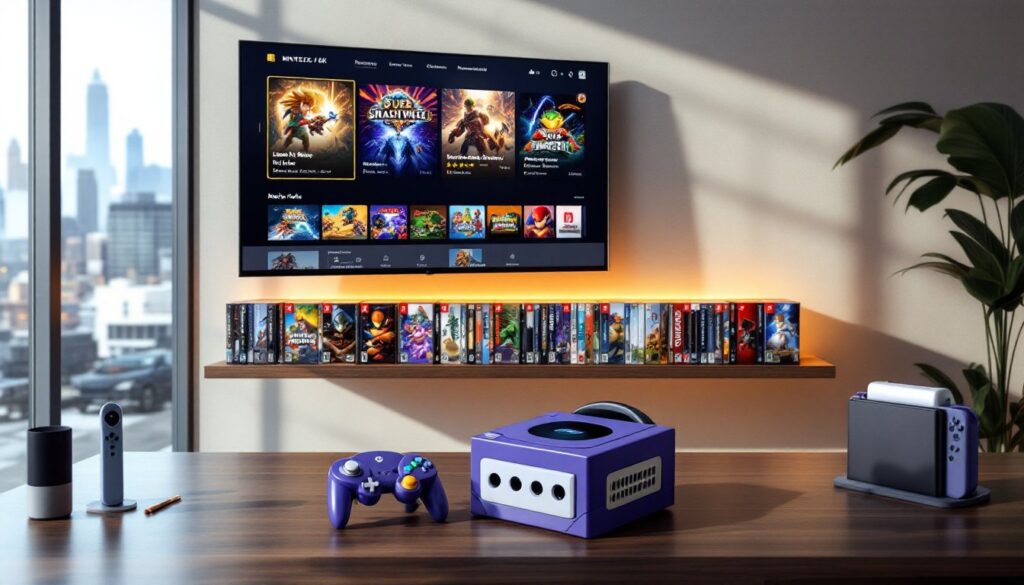
More than two decades after that little purple lunchbox hit shelves, GameCube games still hold up in ways most sixth-gen libraries don’t. The hardware was quirky, the controller was a masterpiece, and the software lineup ran deep with first-party heavy hitters and weird experiments that simply wouldn’t get greenlit today. With Nintendo officially folding GameCube titles into Switch 2’s library in 2025, a whole new generation is about to discover what longtime fans already knew. Here’s a focused look at the classics worth your time in 2026.
Key Takeaways
- GameCube games remain visually and mechanically impressive over two decades later, with first-party classics like Metroid Prime and Resident Evil 4 still setting genre benchmarks.
- Switch 2’s GameCube app integration in 2025 makes it easier than ever to play these titles on modern hardware without hunting for increasingly expensive physical copies.
- Beyond obvious blockbusters, hidden gems like Chibi-Robo, Gotcha Force, and Cubivore showcase the GameCube’s experimental approach and now command high collector prices.
- Physical GameCube games have become investment-grade collectibles, with complete-in-box rarities like Fire Emblem: Path of Radiance exceeding $400.
- Multiple legitimate ways to experience GameCube games in 2026 exist—from original hardware with upscaling cables to Dolphin Emulator on PC, ensuring accessibility for both casual and competitive players.
- Counterfeit GameCube discs and resealed boxes are common among Pokémon titles, making verification through disc hub artwork and case details essential before purchasing rare titles.
Why GameCube Games Still Matter Today
The GameCube sold roughly 21.7 million units worldwide, a commercial flop next to the PS2’s 155 million. But the library punched far above its weight. Titles like Metroid Prime, Resident Evil 4, and F-Zero GX redefined their genres and still get cited as benchmarks in modern reviews.
There’s also the preservation angle. Many GameCube games never got proper re-releases, meaning physical discs and ROMs are the only way in. That scarcity, plus the console’s signature cel-shaded and stylized art direction, has kept resale prices climbing year over year.
And then there’s the controller. Ask any Smash player: the C-stick and those chunky face buttons set a standard competitive players still chase.
Must-Play First-Party Nintendo GameCube Titles
Nintendo’s internal studios were arguably at peak experimentation during the GameCube era. The first-party catalog is small but stacked, and most of these titles are now confirmed or rumored for the Switch 2’s GameCube app, according to reporting from Game Informer on the April 2025 Nintendo Direct.
The Legend of Zelda: The Wind Waker and Twilight Princess
The Wind Waker (2003) caught flak at launch for its cel-shaded look, then aged into one of the most visually timeless games ever made. Its 40fps sailing and dungeon pacing still feel sharp. Twilight Princess (2006) went the opposite direction, moody, realistic, and built around the Wolf Link mechanic. Both are essential, and both represent two completely different philosophies of what a Zelda game can be.
Super Smash Bros. Melee and Mario Kart: Double Dash
Melee is still played competitively in 2026, more than 24 years after release. The wavedashing, L-canceling, and frame-perfect tech created a scene that simply refuses to die. Mario Kart: Double Dash went the other way, two racers per kart, special items per character, and the best co-op kart racer Nintendo has shipped. Polygon’s retrospectives have called it one of the most underappreciated entries in the series.
Hidden Gems and Underrated GameCube Games Worth Revisiting
Beyond the obvious heavy hitters, the GameCube library is loaded with cult favorites that never got their due. A few worth tracking down:
- Chibi-Robo. (2006), A four-inch cleaning robot navigates a dysfunctional family’s house. Stranger and sadder than it sounds.
- Gotcha Force (2003), Capcom’s chaotic arena fighter with 200+ collectible mini-mechs. Resale prices have ballooned past $200.
- Baten Kaitos: Eternal Wings and the Lost Ocean, A card-based JRPG with one of the era’s most divisive twists.
- Cubivore, Published by Atlus, this evolution sim is as weird as anything Nintendo ever shipped.
- P.N.03, Shinji Mikami’s stylish action shooter that flopped commercially but reads as a prototype for Vanquish.
Most of these never hit the Virtual Console, and many didn’t leave Japan. IGN’s retro coverage has been steadily revisiting these oddballs as collector interest grows.
How to Play GameCube Games on Modern Hardware
There are now more legitimate ways to play GameCube titles than at any point in the last decade. The big shift came with Switch 2’s Nintendo Classics expansion, which added a rotating GameCube library starting with The Wind Waker, Soulcalibur II, and F-Zero GX. A breakdown of the current Switch lineup lives in this ultimate play guide for anyone weighing which titles to start with.
Other options:
- Original hardware, Component cables and an OSSC or RetroTINK 4K give the cleanest picture on modern TVs.
- Wii or Wii U, Both play GameCube discs (the Wii does it natively: the Wii U requires homebrew).
- Dolphin Emulator, Open-source, runs on PC and Steam Deck, supports 4K upscaling and widescreen hacks. Dump from discs you own.
Input lag and controller feel matter here. The official GameCube controller adapter for Switch still works on Switch 2, which is the move for Melee purists.
Where to Find and Collect GameCube Games in 2026
Physical collecting has gotten expensive. Loose copies of common games like Luigi’s Mansion sit around $35-50, while complete-in-box rarities like Fire Emblem: Path of Radiance can clear $400. PriceCharting and eBay sold listings are the standard references for accurate market values.
Reliable sources in 2026:
- DKOldies, Lukie Games, eStarland, Tested, refurbished US sellers.
- Japanese imports via Suruga-ya or Mandarake, Often cheaper, region-locked unless modded.
- Local game stores, Underrated for finding loose discs at fair prices.
Watch for resealed boxes and counterfeit discs, Pokémon titles especially. A quick check of the disc’s hub artwork and the case’s J-card thickness usually gives it away. Polygon’s collecting features have covered the counterfeit problem in detail and are worth reading before dropping serious money.