
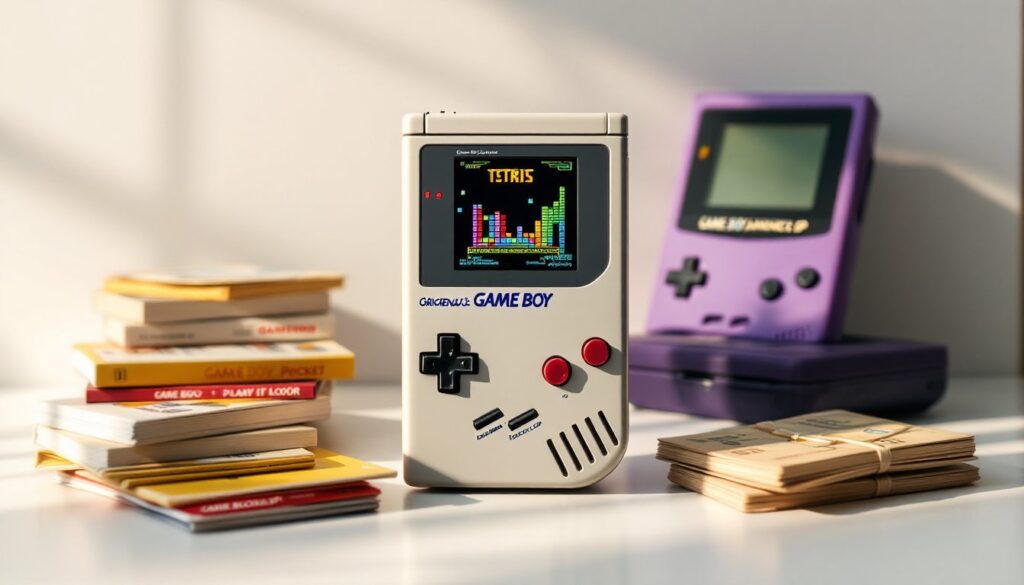
When Gunpei Yokoi’s R&D1 team released the Game Boy in Japan on April 21, 1989, few predicted it would become the most dominant handheld console in gaming history. With over 118 million units sold worldwide, the Game Boy didn’t just change how people played games, it fundamentally shaped the industry. While newer platforms like the Nintendo Switch dominate today’s market, the Game Boy’s legacy remains untouchable. It proved that raw processing power wasn’t everything: smart design, killer software, and portability could beat flashier competitors. Whether you’re a collector restoring a vintage DMG-001 or curious about how Tetris and Pokémon conquered the world through these tiny screens, understanding the Game Boy means understanding modern gaming itself.
Key Takeaways
- The Game Boy revolutionized gaming by proving that smart design and killer software matter more than raw processing power, selling over 118 million units worldwide and becoming the most dominant handheld console in history.
- Game Boy Nintendo demonstrated the success of “Lateral Thinking with Withered Technology,” squeezing maximum gameplay value from practical hardware while iconic franchises like Pokémon and Tetris transformed portable gaming into a cultural phenomenon.
- The Game Boy hardware line evolved from the monochrome DMG-001 through color variants and the 32-bit Game Boy Advance, maintaining backward compatibility and establishing the design blueprint for modern handhelds including the Nintendo Switch.
- Essential Game Boy titles like Pokémon Red/Blue, Tetris, The Legend of Zelda: Link’s Awakening, and Game Boy Advance classics remain system-defining experiences that justify why these games command premium prices in today’s collector market.
- Game Boy collecting has become a thriving hobby with enthusiasts performing IPS screen replacements, backlight mods, and careful restoration while preserving these durable machines that were engineered to survive decades of use.
- The Game Boy’s legacy continues to influence modern portable gaming design, representing the turning point where gaming became truly personal and accessible—a foundation that Nintendo’s current and future handheld systems still build upon today.
What Is The Game Boy And Why It Matters Today
The Game Boy is an 8-bit handheld cartridge console that combined NES-style gameplay with portability. It standardized how portable gaming worked and became the blueprint for every handheld that followed, including the Nintendo DS, 3DS, and even influenced modern mobile gaming architecture. What made it special wasn’t technical specs, the Game Boy’s screen was monochrome, its processor modest by contemporary standards. Instead, Yokoi’s philosophy of “Lateral Thinking with Withered Technology” meant squeezing maximum gameplay value from practical hardware. The system powered iconic franchises like Pokémon and Tetris into global phenomena, proving that accessibility and software library mattered more than raw horsepower. Today, the Game Boy still holds cultural weight. Collectors hunt vintage cartridges, modders install modern screens and LEDs into original shells, and speedrunners set world records on 35-year-old hardware. The platform represents a turning point where gaming became truly personal and portable, a foundation the Nintendo Switch 2 and modern handhelds still build upon.
The Evolution Of Game Boy Hardware Through The Decades
The Game Boy line spanned nearly two decades, with each iteration improving processing power, screen quality, and battery life while maintaining backward compatibility where possible.
Original Game Boy And Color Variants
The Original Game Boy (DMG-001) launched in 1989 with an 8-bit custom CPU running at ~2.2 MHz, a 2.6-inch 4-shade monochrome LCD, and 4-channel sound. It required four AA batteries for roughly 15 hours of gameplay. Nintendo released it in gray, then later in bold “Play It Loud.” colors and special editions, a strategy that kept the hardware fresh even though minimal technical changes.
The Game Boy Pocket (1996/1997) trimmed the fat: smaller, lighter, with an improved contrast screen and just two AAA batteries. While still monochrome, it felt like a major quality-of-life upgrade.
The Game Boy Color (1998) was the real game-changer. It featured a color LCD displaying up to 56 colors on-screen simultaneously, a faster CPU, and crucially, backward compatibility with original Game Boy cartridges (though some games showed in original monochrome unless specifically programmed for color). The GBC had its own exclusive software library too, Pokémon Gold/Silver/Crystal and dozens of color-enhanced titles justified the upgrade. Popular variants included Atomic Purple, Teal, and licensed editions.
Advance And Modern Successors
The Game Boy Advance (2001) jumped to 32-bit ARM-based processing with a wider screen and SNES-quality graphics. Cartridges couldn’t physically accept original Game Boy games, but the library was stacked: Pokémon Ruby/Sapphire/Emerald, Advance Wars, Golden Sun, and Castlevania: Aria of Sorrow set new standards for handheld gaming. Titles like Nintendo Switch games represent how that DNA evolved.
The Game Boy Advance SP (2003) brought the clamshell form factor with front-lit screens, later revised with backlit panels, a feature handheld gamers still crave. The Game Boy Micro (2005) was a tiny, aggressive redesign that dropped GB/GBC cartridge support entirely and found a niche audience.
After 2005, the Game Boy brand retired. The Nintendo DS (2004) and 3DS (2011) carried forward the legacy with dual screens, touch input, and stereoscopic 3D, maintaining backward compatibility where applicable. These successors paved the way toward today’s Nintendo Switch, which reframed handheld gaming for a new generation, though the original Game Boy’s design philosophy still echoes in every portable Nintendo console.
Iconic Game Boy Games That Defined A Generation
The Game Boy’s software library made the hardware matter. Without killer apps, even the best handheld is just plastic and circuits.
Tetris arrived as a pack-in game in many regions and became a system-seller on its own. Simple, addictive, infinitely replayable, it proved puzzle games could drive hardware adoption.
Pokémon Red/Green/Blue/Yellow (1996–1998) transformed portable gaming from novelty to cultural force. Kids everywhere carried their Game Boys to swap Pokémon with friends via link cables. The franchise’s explosive growth directly tied to the Game Boy’s reach and accessibility. According to gaming industry coverage, Pokémon’s trading mechanic fundamentally changed how developers thought about multiplayer on handhelds.
Other foundational titles included:
- Super Mario Land series: Platforming excellence adapted for smaller screens
- The Legend of Zelda: Link’s Awakening: A full-fat Zelda experience on a handheld (later remade for Nintendo Switch)
- Metroid II: Return of Samus: Solid action-adventure gameplay
- Wario Land series: Creative platforming with unique mechanics
- Kirby’s Dream Land: Classic Nintendo charm
On Game Boy Color, games like Pokémon Gold/Silver/Crystal and Gold/Silver/Ruby/Sapphire cemented the RPG dominance. The Game Boy Advance era delivered Advance Wars (tactical strategy), Golden Sun (JRPG brilliance), and Castlevania: Aria of Sorrow (one of the best 2D action games ever). Research from Game Rant shows these titles still command premium prices in the collector’s market, underscoring their lasting appeal.
These games weren’t just good, they were system-defining experiences that justified buying the hardware. That’s a lesson modern developers still chase.
Collecting And Maintaining Game Boy Devices Today
The Game Boy collecting scene is thriving. Whether restoring a beat-up 1989 DMG or hunting a Japan-only Game Boy Light, collectors treat these devices seriously.
Hardware priorities include condition of the screen (cracks or dead pixels kill value), battery compartment integrity (corrosion is a dealbreaker), functioning audio and buttons, and original shells. Rare variants like the Play It Loud. editions, Game Boy Pocket in silver, and Game Boy Advance SP in uncommon colors command premiums. Complete-in-box examples with manuals and original packaging fetch significantly more than loose cartridges.
Modern maintenance has evolved thanks to enthusiast communities. Common upgrades include:
- IPS LCD screen replacements: Swapping the original monochrome or dim LCD for modern high-contrast displays while keeping the original shell
- Backlight/frontlight mods: Installing LED backlighting in DMG and GBA units for better visibility
- Power board recapping: Replacing aging capacitors to prevent battery leaks and power failures
- Shell and button replacements: Using high-quality reproductions to restore cosmetics without destroying originality
Storage and care require specificity. Remove batteries during long storage to prevent corrosion. Keep devices in dry, temperature-stable environments, heat and humidity degrade electronics and damage screens. Clean contacts with proper electronics-grade cleaners: avoid abrasive materials that scratch PCBs. Protective cases preserve condition, though collectors debate whether to prioritize playability (install mods, use daily) or preservation (keep sealed, museum-quality).
According to Kotaku’s coverage of retro gaming trends, Game Boy restoration has become a legitimate hobby and small business. Communities like r/Gameboy on Reddit share repair guides, mod tutorials, and trading posts daily. A well-maintained or tastefully modded Game Boy from the 1990s remains a functional, playable console, not just a collectible artifact.
The investment in Game Boy collecting reflects the hardware’s durability. These machines were designed to survive childhood: dropped, banged around, exposed to sand and spills. Thirty-five years later, many still work. That’s durability engineering from an era when planned obsolescence wasn’t standard practice.
Conclusion
The Game Boy established the template for modern handheld gaming. Its hardware line, from the original DMG through the Game Boy Advance, bridged 8-bit monochrome portables to 32-bit color systems while maintaining a consistent design philosophy: robust, efficient, and game-first. Franchises like Tetris and Pokémon didn’t just succeed because of the Game Boy: they shaped the device’s legacy. Today, these systems remain actively collected, restored, and genuinely played by gamers who appreciate efficient design and legendary software. Whether you’re exploring the history behind the Nintendo Switch’s portability or hunting your childhood Game Boy, understanding this handheld means understanding how gaming became personal.